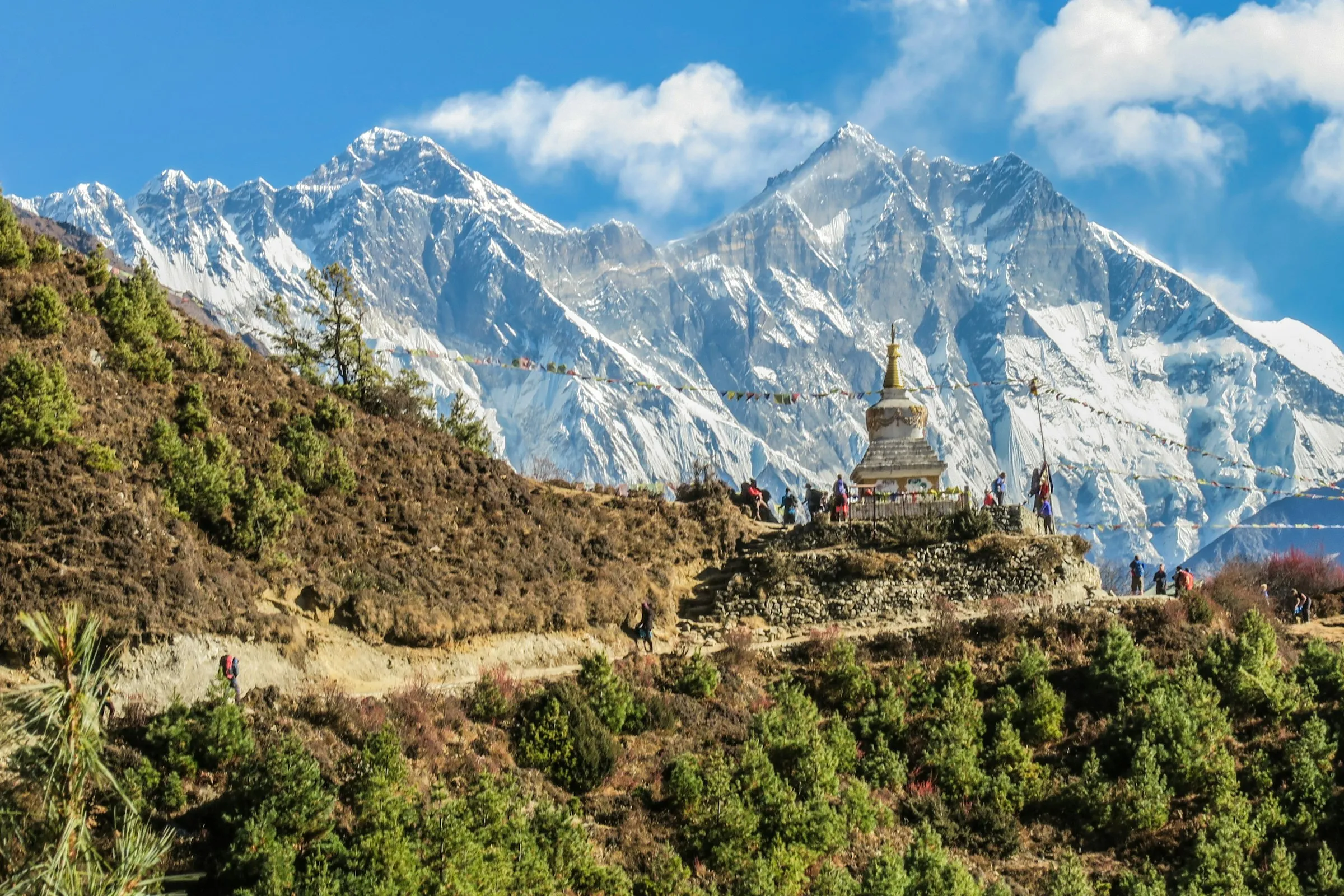
Challenging. 12 days, and you sleep highest at 5,164 m, with 9 nights above 3,000 m. The biggest climb is +830 m in a day, to Namche Bazaar. 3 nights climb faster than the 500 m/day altitude guideline.
At a glance
| Our grade | Challenging, 4 of 5 |
|---|---|
| Days, Kathmandu to Kathmandu | 12 |
| High point | Kala Patthar, 5,545 m |
| Highest night | 5,164 m |
| Nights above 3,000 m | 9 |
| Biggest climb in a day | +830 m to Namche Bazaar |
| Rest days at altitude | 2 |
| Nights over the 500 m/day guideline | 3 |
| Technical skills | None: walking only |
Day by day: where you sleep and how far you climb
| Day | The day | Sleep at | Altitude | Change |
|---|---|---|---|---|
| 1 | Fly to Lukla, trek to Phakding | Phakding | 2,610 m | – |
| 2 | Trek to Namche Bazaar | Namche Bazaar | 3,440 m | +830 mover |
| 3 | Acclimatisation day in Namche | Namche Bazaar | 3,440 m | rest day |
| 4 | Trek to Tengboche | Tengboche | 3,860 m | +420 m |
| 5 | Trek to Dingboche | Dingboche | 4,410 m | +550 mover |
| 6 | Acclimatisation day in Dingboche | Dingboche | 4,410 m | rest day |
| 7 | Trek to Lobuche | Lobuche | 4,940 m | +530 mover |
| 8 | Trek to Gorak Shep, visit Everest Base Camp · high point Everest Base Camp, 5,364 m | Gorak Shep | 5,164 m | +224 m |
| 9 | Sunrise on Kala Patthar, descend to Pheriche · high point Kala Patthar, 5,545 m | Pheriche | 4,240 m | −924 m |
| 10 | Trek to Namche Bazaar | Namche Bazaar | 3,440 m | −800 m |
| 11 | Trek to Lukla | Lukla | 2,860 m | −580 m |
| 12 | Fly back to Kathmandu | Off the trail | – | – |
Altitudes are where you sleep. "Over" marks a night above 3,000 m that climbs more than 500 m from the night before, the limit in the altitude guideline. Days without a listed stop are travel days.
Altitude check
3 nights climb faster than the guideline; 2 rest days are built in.
- Day 2 Namche Bazaar, 3,440 m +830 m
- Day 5 Dingboche, 4,410 m +550 m
- Day 7 Lobuche, 4,940 m +530 m
On these days your guide keeps the pace slow and checks how you feel. Want more margin? Ask us to add an acclimatisation night.
Guideline: once above 3,000 m, raise where you sleep by no more than about 500 m a day (Wilderness Medical Society, 2024). Calculated from this itinerary. Check another itinerary →
Compared with our other treks
| Trek | Days | Highest night | Nights > 3,000 m | Biggest climb | Over guideline | Grade |
|---|---|---|---|---|---|---|
| Everest Base Camp | 12 | 5,164 m | 9 | +830 m | 3 | Challenging |
| Annapurna Circuit | 12 | 4,450 m | 6 | +966 m | 2 | Challenging |
| Circuit + Tilicho | 15 | 4,450 m | 9 | +966 m | 2 | Challenging |
| Annapurna Base Camp | 10 | 4,130 m | 2 | +920 m | 2 | Moderate to challenging |
None of our other 8 treks sleeps higher than this one. The three above are the nearest in altitude. Compare any two side by side →
Everest Base Camp needs no climbing skills, but it takes you higher than any of our other treks. You sleep above 3,000 m on most nights, and above 5,000 m at Gorak Shep, where the air holds roughly half the oxygen it does at sea level.
The hard parts
- The climb to Namche Bazaar. Day two crosses the Dudh Koshi on high suspension bridges, then climbs steeply for hours to Namche at 3,440 m.
- Day after day above 4,000 m. From Dingboche onwards, you walk slowly, sleep lightly and eat less. This is normal, and it’s why the itinerary includes two rest days.
- Gorak Shep and Kala Patthar. Gorak Shep (5,164 m) is cold and basic, and Kala Patthar (5,545 m) is a climb of about 380 m above it, started before dawn in the cold.
- Lukla flights. Weather often delays flights in and out of Lukla, so build in spare time.
How to train
- Walk hills or stairs two or three times a week for eight to ten weeks before you go.
- Do back-to-back long walks with the pack you’ll carry.
- Build general fitness, but don’t expect it to protect you from altitude sickness. Pacing and acclimatisation do that.
Who it suits
Fit walkers who are comfortable with basic lodges, cold nights and slow days at altitude. If you have heart, lung or blood-pressure problems, talk to your doctor before booking.
Questions people ask
What is the hardest day on the Everest Base Camp trek?
Day 2, Trek to Namche Bazaar: a climb of +830 m. 3 nights on this itinerary climb faster than the 500 m a day guideline; the altitude check above lists them.
How many nights above 3,000 m are there on Everest Base Camp?
9 nights, the highest at 5,164 m. 2 rest days at altitude are built in.
Is Everest Base Camp harder than our other treks?
It is the highest-sleeping trek we run; all 8 others sleep lower. Nearest in altitude: Annapurna Circuit (4,450 m), Circuit + Tilicho (4,450 m), Annapurna Base Camp (4,130 m). The comparison table on this page puts them side by side.
Do I need climbing skills for Everest Base Camp?
No. It is a walking trek on trails and stone steps; no ropes, crampons or technical skills. What makes it challenging is altitude and consecutive long days.
Related reading
- SIM cards, Wi-Fi and charging on a Nepal trek · Which SIM to buy in Kathmandu, where phones lose signal on the Everest and Annapurna trails, teahouse Wi-Fi an…
- Nepal visa on arrival for trekkers: fees, the online form and how long you can stay · Nepal tourist visa costs for 15, 30 or 90 days, the online pre-arrival form, what to bring to the airport, and…
- Nepal trekking calendar 2027: seasons, festivals and the dates that affect your trek · The 2027 trekking seasons month by month, the festival dates that fill buses and lodges, when Lukla flights mo…
- Lukla flights from Ramechhap: how the Everest flight actually works · In peak season Lukla flights leave from Ramechhap, 4 to 5 hours from Kathmandu. What that means for your Evere…
- An eight-week training plan for Everest Base Camp · A simple eight-week plan to get ready for Everest Base Camp, built around long walks with a pack and back-to-b…
- How many days do you need for Everest Base Camp? · Why our Everest Base Camp trek takes 12 days, what 10-day itineraries cut, what a 14-day version adds, and how…