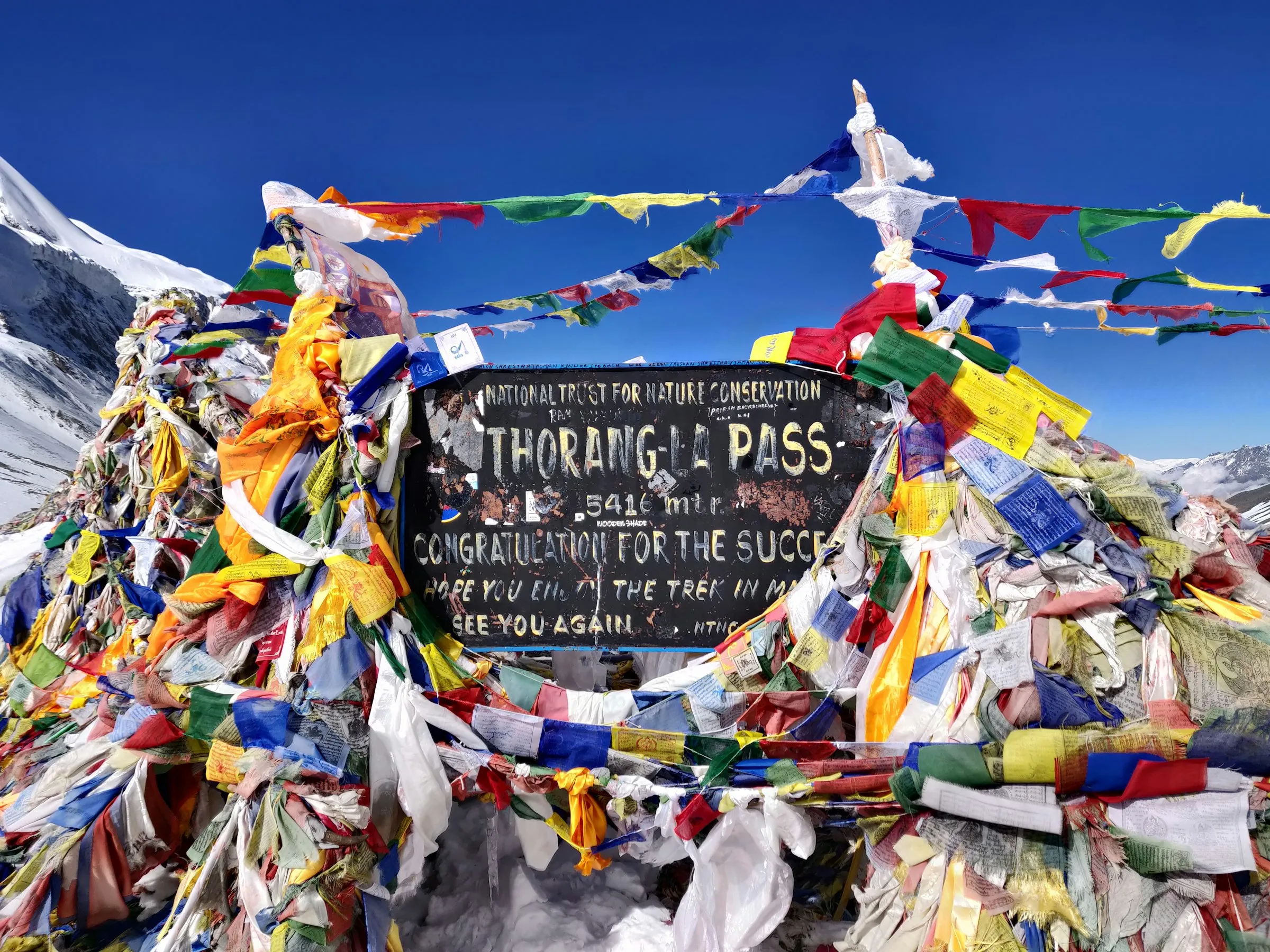
Challenging. 12 days, and you sleep highest at 4,450 m, with 6 nights above 3,000 m. The biggest climb is +966 m in a day, to Thorong La Pass. 2 nights climb faster than the 500 m/day altitude guideline.
At a glance
| Our grade | Challenging, 4 of 5 |
|---|---|
| Days, Kathmandu to Kathmandu | 12 |
| High point | Thorong La Pass, 5,416 m |
| Highest night | 4,450 m |
| Nights above 3,000 m | 6 |
| Biggest climb in a day | +966 m to Thorong La Pass |
| Rest days at altitude | 1 |
| Nights over the 500 m/day guideline | 2 |
| Technical skills | None: walking only |
Day by day: where you sleep and how far you climb
| Day | The day | Sleep at | Altitude | Change |
|---|---|---|---|---|
| 1 | Drive from Kathmandu to Besisahar | Besisahar | 760 m | – |
| 2 | Drive and trek up the Marsyangdi valley | Off the trail | – | – |
| 3 | Trek to Chame | Chame | 2,670 m | +1,910 m |
| 4 | Trek to Upper Pisang | Upper Pisang | 3,300 m | +630 mover |
| 5 | Trek to Manang | Manang | 3,540 m | +240 m |
| 6 | Acclimatisation day in Manang | Manang | 3,540 m | rest day |
| 7 | Trek to Yak Kharka | Yak Kharka | 4,050 m | +510 mover |
| 8 | Trek to Thorong Phedi | Thorong Phedi | 4,450 m | +400 m |
| 9 | Cross Thorong La, descend to Muktinath · high point Thorong La Pass, 5,416 m | Muktinath | 3,760 m | −690 m |
| 10 | Descend to Jomsom | Jomsom | 2,720 m | −1,040 m |
| 11 | Fly or drive to Pokhara | Off the trail | – | – |
| 12 | Tourist bus back to Kathmandu | Off the trail | – | – |
Altitudes are where you sleep. "Over" marks a night above 3,000 m that climbs more than 500 m from the night before, the limit in the altitude guideline. Days without a listed stop are travel days.
Altitude check
2 nights climb faster than the guideline; 1 rest day is built in.
- Day 4 Upper Pisang, 3,300 m +630 m
- Day 7 Yak Kharka, 4,050 m +510 m
On these days your guide keeps the pace slow and checks how you feel. Want more margin? Ask us to add an acclimatisation night.
Guideline: once above 3,000 m, raise where you sleep by no more than about 500 m a day (Wilderness Medical Society, 2024). Calculated from this itinerary. Check another itinerary →
Compared with our other treks
| Trek | Days | Highest night | Nights > 3,000 m | Biggest climb | Over guideline | Grade |
|---|---|---|---|---|---|---|
| Annapurna Circuit | 12 | 4,450 m | 6 | +966 m | 2 | Challenging |
| Circuit + Tilicho | 15 | 4,450 m | 9 | +966 m | 2 | Challenging |
| Annapurna Base Camp | 10 | 4,130 m | 2 | +920 m | 2 | Moderate to challenging |
| ABC + Poon Hill | 12 | 4,130 m | 2 | +920 m | 2 | Moderate to challenging |
Of our 9 treks, 1 sleep higher and 7 sleep lower than this one. The three above are the nearest in altitude. Compare any two side by side →
The Annapurna Circuit is long rather than steep for most of its length. The climb up the Marsyangdi valley is spread over a week, with a rest day in Manang, but two nights still climb more than the 500 m guideline (Day 4 +630 m to Upper Pisang, Day 7 +510 m to Yak Kharka); ask us to add an acclimatisation night. Then comes one very hard day: crossing Thorong La at 5,416 m.
The hard parts
- Thorong La day. You start before dawn from Thorong Phedi or High Camp, climb to 5,416 m in thin, cold air, then descend a long, steep path to Muktinath at 3,760 m. Expect a very long day.
- Cold. Nights at Yak Kharka and Thorong Phedi are well below freezing outside the summer months.
- Altitude. You sleep above 3,000 m for several nights in a row. The rest day in Manang matters; don’t skip it.
How to train
- Walk hills or stairs two or three times a week for eight to ten weeks before you go.
- Include some long days of six hours or more, ideally with a steep descent, to prepare for the pass.
- Practise walking downhill with poles. The descent to Muktinath is hard on knees.
When not to cross
Snow can close Thorong La, especially from December to February, and after late snow. Your guide decides on the morning whether it’s safe to cross, and waiting a day is sometimes the right call.
Questions people ask
What is the hardest day on the Annapurna Circuit trek?
Day 9, Cross Thorong La, descend to Muktinath: a climb of +966 m to the high point at 5,416 m. 2 nights on this itinerary climb faster than the 500 m a day guideline; the altitude check above lists them.
How many nights above 3,000 m are there on Annapurna Circuit?
6 nights, the highest at 4,450 m. 1 rest day at altitude is built in.
Is Annapurna Circuit harder than our other treks?
1 of our treks sleep higher and 7 sleep lower. Nearest in altitude: Circuit + Tilicho (4,450 m), Annapurna Base Camp (4,130 m), ABC + Poon Hill (4,130 m). The comparison table on this page puts them side by side.
Do I need climbing skills for Annapurna Circuit?
No. It is a walking trek on trails and stone steps; no ropes, crampons or technical skills. What makes it challenging is altitude and consecutive long days.
Related reading
- SIM cards, Wi-Fi and charging on a Nepal trek · Which SIM to buy in Kathmandu, where phones lose signal on the Everest and Annapurna trails, teahouse Wi-Fi an…
- Nepal visa on arrival for trekkers: fees, the online form and how long you can stay · Nepal tourist visa costs for 15, 30 or 90 days, the online pre-arrival form, what to bring to the airport, and…
- Nepal trekking calendar 2027: seasons, festivals and the dates that affect your trek · The 2027 trekking seasons month by month, the festival dates that fill buses and lodges, when Lukla flights mo…
- An eight-week training plan for Everest Base Camp · A simple eight-week plan to get ready for Everest Base Camp, built around long walks with a pack and back-to-b…
- Is the Annapurna Circuit still worth it with the road? · Where the jeep road now runs on the Annapurna Circuit, which days it affects, how our itinerary avoids it, and…
- Trekking in Nepal in January and February: what works · Can you trek in Nepal in January or February? Night temperatures on six treks, which treks list February as po…