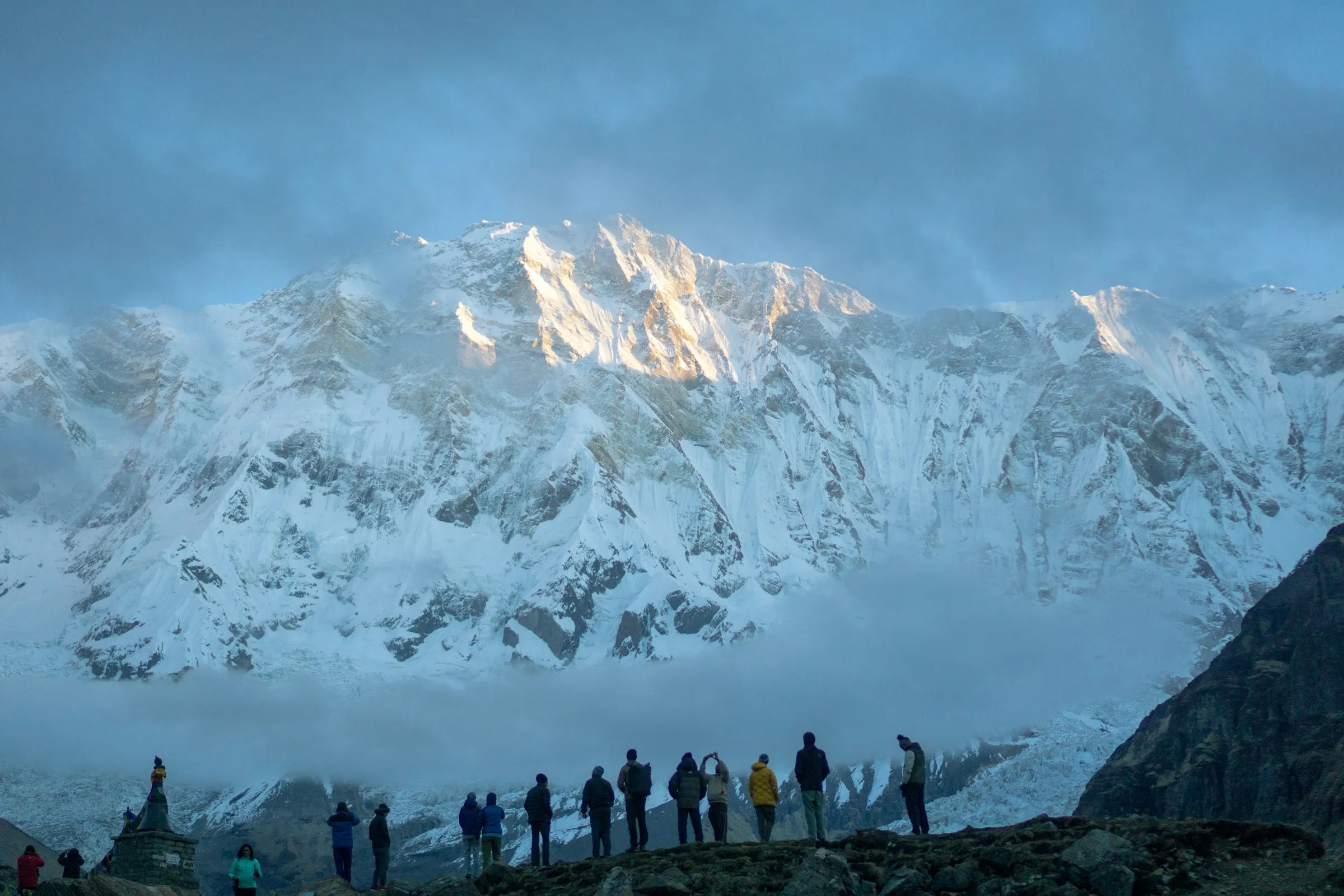
Moderate to challenging. 10 days, and you sleep highest at 4,130 m, with 2 nights above 3,000 m. The biggest climb is +920 m in a day, to Deurali. 2 nights climb faster than the 500 m/day altitude guideline.
At a glance
| Our grade | Moderate to challenging, 3 of 5 |
|---|---|
| Days, Kathmandu to Kathmandu | 10 |
| High point | Annapurna Base Camp, 4,130 m |
| Highest night | 4,130 m |
| Nights above 3,000 m | 2 |
| Biggest climb in a day | +920 m to Deurali |
| Rest days at altitude | None |
| Nights over the 500 m/day guideline | 2 |
| Technical skills | None: walking only |
Day by day: where you sleep and how far you climb
| Day | The day | Sleep at | Altitude | Change |
|---|---|---|---|---|
| 1 | Tourist bus from Kathmandu to Pokhara | Off the trail | – | – |
| 2 | Drive from Pokhara, trek to Ghandruk | Ghandruk | 1,940 m | – |
| 3 | Trek to Chhomrong | Chhomrong | 2,170 m | +230 m |
| 4 | Trek to Bamboo | Bamboo | 2,310 m | +140 m |
| 5 | Trek to Deurali | Deurali | 3,230 m | +920 mover |
| 6 | Trek via Machapuchare Base Camp to Annapurna Base Camp | Annapurna Base Camp | 4,130 m | +900 mover |
| 7 | Descend to Bamboo | Bamboo | 2,310 m | −1,820 m |
| 8 | Trek to Chhomrong | Chhomrong | 2,170 m | −140 m |
| 9 | Trek down and drive to Pokhara | Off the trail | – | – |
| 10 | Tourist bus back to Kathmandu | Off the trail | – | – |
Altitudes are where you sleep. "Over" marks a night above 3,000 m that climbs more than 500 m from the night before, the limit in the altitude guideline. Days without a listed stop are travel days.
Altitude check
2 nights climb faster than the guideline.
- Day 5 Deurali, 3,230 m +920 m
- Day 6 Annapurna Base Camp, 4,130 m +900 m
On these days your guide keeps the pace slow and checks how you feel. Want more margin? Ask us to add an acclimatisation night.
Guideline: once above 3,000 m, raise where you sleep by no more than about 500 m a day (Wilderness Medical Society, 2024). Calculated from this itinerary. Check another itinerary →
Compared with our other treks
| Trek | Days | Highest night | Nights > 3,000 m | Biggest climb | Over guideline | Grade |
|---|---|---|---|---|---|---|
| Annapurna Base Camp | 10 | 4,130 m | 2 | +920 m | 2 | Moderate to challenging |
| ABC + Poon Hill | 12 | 4,130 m | 2 | +920 m | 2 | Moderate to challenging |
| Langtang Valley | 8 | 3,870 m | 3 | +1,010 m | 1 | Moderate |
| Annapurna Circuit | 12 | 4,450 m | 6 | +966 m | 2 | Challenging |
Of our 9 treks, 3 sleep higher and 5 sleep lower than this one. The three above are the nearest in altitude. Compare any two side by side →
Annapurna Base Camp is a good first Himalayan trek if you want to go above 4,000 m. It is still a real challenge: you walk most of every day, often on steep stone steps, and you finish at 4,130 m.
The hard parts
- Stone staircases. The trail around Chhomrong drops steeply to the Chhomrong Khola river and climbs back up the far side, on thousands of uneven stone steps. You pass this way twice.
- The climb into the Sanctuary. Day 5 climbs about 920 m from Bamboo to Deurali (3,230 m), and Day 6 another 900 m past Machapuchare Base Camp to Annapurna Base Camp (4,130 m).
- Altitude. You sleep one night at 4,130 m, and altitude sickness doesn’t depend on fitness. Two nights climb more than the 500 m guideline (Day 5 +920 m, Day 6 +900 m); ask us to add an acclimatisation night.
How to train
- Walk hills or stairs two or three times a week for six to eight weeks before you go.
- Do at least a few long walks with the pack you’ll carry, back to back on consecutive days.
- Practise descents too. Going down hundreds of steps is hard on your knees; trekking poles help.
Who it suits
If you can walk for five or six hours with breaks and feel fine the next morning, you can train for this. If you have heart, lung or joint problems, talk to your doctor first.
Questions people ask
What is the hardest day on the Annapurna Base Camp trek?
Day 5, Trek to Deurali: a climb of +920 m. 2 nights on this itinerary climb faster than the 500 m a day guideline; the altitude check above lists them.
How many nights above 3,000 m are there on Annapurna Base Camp?
2 nights, the highest at 4,130 m. There is no rest day built in; ask us to add one if you want more margin.
Is Annapurna Base Camp harder than our other treks?
3 of our treks sleep higher and 5 sleep lower. Nearest in altitude: ABC + Poon Hill (4,130 m), Langtang Valley (3,870 m), Annapurna Circuit (4,450 m). The comparison table on this page puts them side by side.
Do I need climbing skills for Annapurna Base Camp?
No. It is a walking trek on trails and stone steps; no ropes, crampons or technical skills. What makes it moderate to challenging is altitude and consecutive long days.
Related reading
- SIM cards, Wi-Fi and charging on a Nepal trek · Which SIM to buy in Kathmandu, where phones lose signal on the Everest and Annapurna trails, teahouse Wi-Fi an…
- Nepal visa on arrival for trekkers: fees, the online form and how long you can stay · Nepal tourist visa costs for 15, 30 or 90 days, the online pre-arrival form, what to bring to the airport, and…
- Nepal trekking calendar 2027: seasons, festivals and the dates that affect your trek · The 2027 trekking seasons month by month, the festival dates that fill buses and lodges, when Lukla flights mo…
- An eight-week training plan for Everest Base Camp · A simple eight-week plan to get ready for Everest Base Camp, built around long walks with a pack and back-to-b…
- How many days do you need for Annapurna Base Camp? · Seven walking days is the core of the Annapurna Base Camp trek. How that becomes 10 days from Kathmandu, 12 wi…
- Trekking solo in Nepal in 2026: what the guide rule means if you travel alone · Travelling alone? What the 2023 guide rule means for solo trekkers in 2026, where it does not apply, and how t…