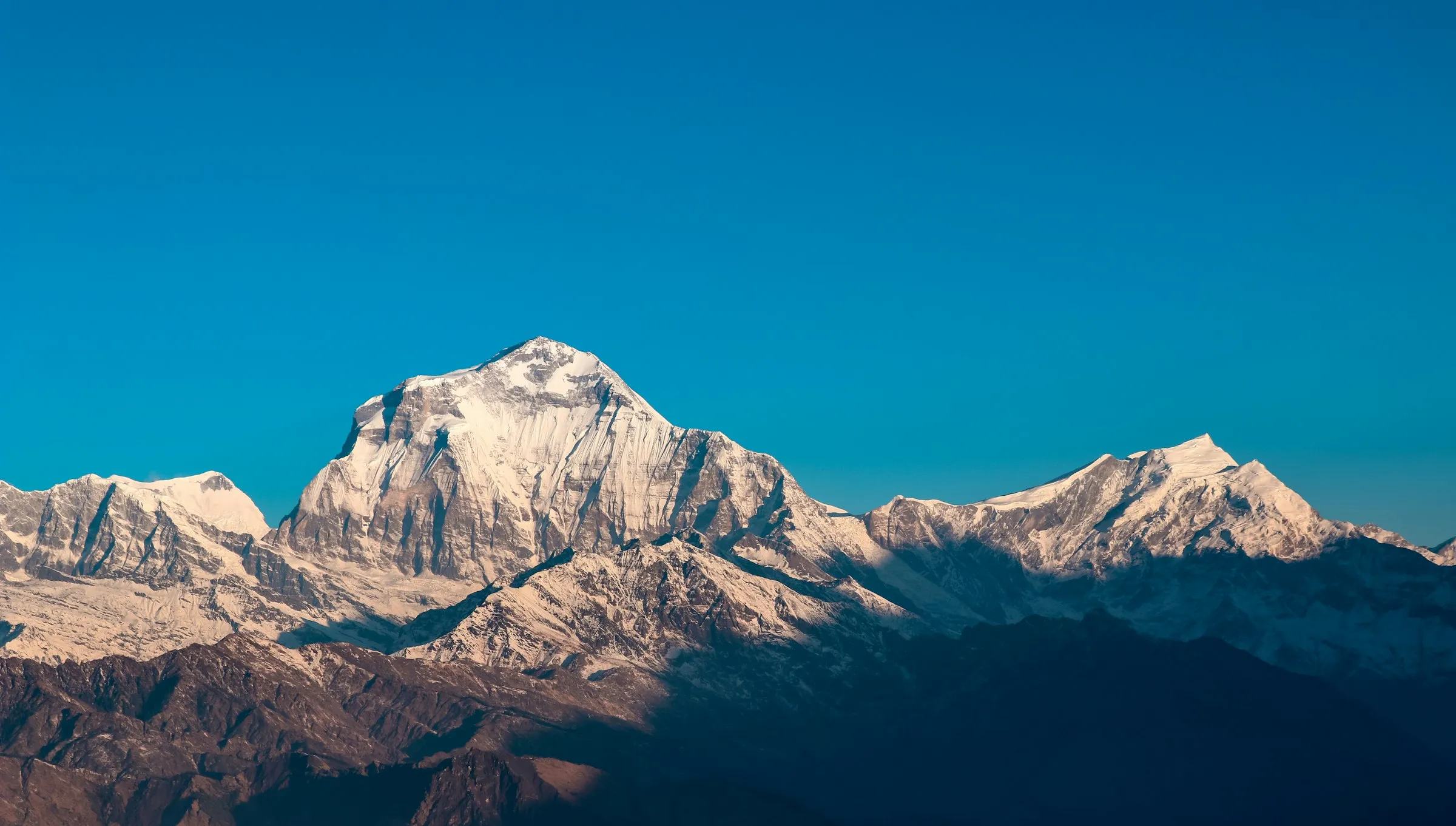
Moderate. 10 days, and you sleep highest at 3,640 m, with 3 nights above 3,000 m. The biggest climb is +850 m in a day, to Ghorepani. 2 nights climb faster than the 500 m/day altitude guideline.
At a glance
| Our grade | Moderate, 3 of 5 |
|---|---|
| Days, Kathmandu to Kathmandu | 10 |
| High point | Khopra Danda, 3,640 m |
| Highest night | 3,640 m |
| Nights above 3,000 m | 3 |
| Biggest climb in a day | +850 m to Ghorepani |
| Rest days at altitude | None |
| Nights over the 500 m/day guideline | 2 |
| Technical skills | None: walking only |
Day by day: where you sleep and how far you climb
| Day | The day | Sleep at | Altitude | Change |
|---|---|---|---|---|
| 1 | Tourist bus from Kathmandu to Pokhara | Off the trail | – | – |
| 2 | Drive to Nayapul, trek to Ulleri | Ulleri | 2,010 m | – |
| 3 | Trek to Ghorepani | Ghorepani | 2,860 m | +850 m |
| 4 | Sunrise on Poon Hill, trek to Swanta · high point Poon Hill, 3,210 m | Swanta | 2,240 m | −620 m |
| 5 | Trek to Chistibung | Chistibung | 3,040 m | +800 mover |
| 6 | Trek up to Khopra Danda | Khopra Danda | 3,640 m | +600 mover |
| 7 | Trek to Dobato | Dobato | 3,450 m | −190 m |
| 8 | Trek to Tadapani | Tadapani | 2,680 m | −770 m |
| 9 | Trek to Ghandruk, drive to Pokhara | Ghandruk | 1,940 m | −740 m |
| 10 | Tourist bus back to Kathmandu | Off the trail | – | – |
Altitudes are where you sleep. "Over" marks a night above 3,000 m that climbs more than 500 m from the night before, the limit in the altitude guideline. Days without a listed stop are travel days.
Altitude check
2 nights climb faster than the guideline.
- Day 5 Chistibung, 3,040 m +800 m
- Day 6 Khopra Danda, 3,640 m +600 m
On these days your guide keeps the pace slow and checks how you feel. Want more margin? Ask us to add an acclimatisation night.
Guideline: once above 3,000 m, raise where you sleep by no more than about 500 m a day (Wilderness Medical Society, 2024). Calculated from this itinerary. Check another itinerary →
Compared with our other treks
| Trek | Days | Highest night | Nights > 3,000 m | Biggest climb | Over guideline | Grade |
|---|---|---|---|---|---|---|
| Khopra Danda | 10 | 3,640 m | 3 | +850 m | 2 | Moderate |
| Mardi Himal | 8 | 3,540 m | 1 | +615 m | 1 | Moderate |
| Langtang Valley | 8 | 3,870 m | 3 | +1,010 m | 1 | Moderate |
| Annapurna Base Camp | 10 | 4,130 m | 2 | +920 m | 2 | Moderate to challenging |
Of our 9 treks, 6 sleep higher and 2 sleep lower than this one. The three above are the nearest in altitude. Compare any two side by side →
Khopra Danda is a moderate trek. It starts like Poon Hill, then leaves the main teahouse trail and climbs to a high ridge, which makes it longer and higher than Poon Hill but still well below the big base-camp treks.
The hard parts
- The steps to Ulleri and the Poon Hill sunrise. The same stone staircases and pre-dawn climb as the Poon Hill trek.
- Swanta to Chistibung. About 800 m of climbing in one day, mostly through forest.
- Up to Khopra Danda. Another 600 m to the ridge at 3,640 m.
- Over to Dobato and down to Ghandruk. Long days on rougher, quieter trails than the main routes.
Altitude
You sleep at 3,640 m on Khopra Danda, high enough for altitude sickness. Two nights climb more than the 500 m guideline (Day 5 +800 m to Chistibung, Day 6 +600 m to Khopra Danda); ask us to add an acclimatisation night. If you feel unwell, tell your guide and don’t go higher.
Who it suits
Walkers who’ve done Poon Hill or similar, or anyone who wants a quiet trek with big mountain views without going above 4,000 m.
Questions people ask
What is the hardest day on the Khopra Danda trek?
Day 3, Trek to Ghorepani: a climb of +850 m. 2 nights on this itinerary climb faster than the 500 m a day guideline; the altitude check above lists them.
How many nights above 3,000 m are there on Khopra Danda?
3 nights, the highest at 3,640 m. There is no rest day built in; ask us to add one if you want more margin.
Is Khopra Danda harder than our other treks?
6 of our treks sleep higher and 2 sleep lower. Nearest in altitude: Mardi Himal (3,540 m), Langtang Valley (3,870 m), Annapurna Base Camp (4,130 m). The comparison table on this page puts them side by side.
Do I need climbing skills for Khopra Danda?
No. It is a walking trek on trails and stone steps; no ropes, crampons or technical skills. What makes it moderate is altitude and consecutive long days.
Related reading
- Trekking Poon Hill with children: what works and what to change · Why families pick Poon Hill, what the stone steps and the 3,210 m sunrise mean for children, and how to plan t…
- Nepal trekking calendar 2027: seasons, festivals and the dates that affect your trek · The 2027 trekking seasons month by month, the festival dates that fill buses and lodges, when Lukla flights mo…
- Trekking in Nepal in January and February: what works · Can you trek in Nepal in January or February? Night temperatures on six treks, which treks list February as po…
- Trekking in Nepal in October: what to expect · Why October is peak season for Nepal treks, what the weather is like on each trail, festivals, crowds and how …
- Short treks from Pokhara · Our short treks from Pokhara, from a few days at Poon Hill to a week to Annapurna Base Camp, and how to choose…
- Nepal trekking in December: which treks work · Is December a good month to trek in Nepal? Clear skies, quiet trails and cold nights, and how each of our trek…