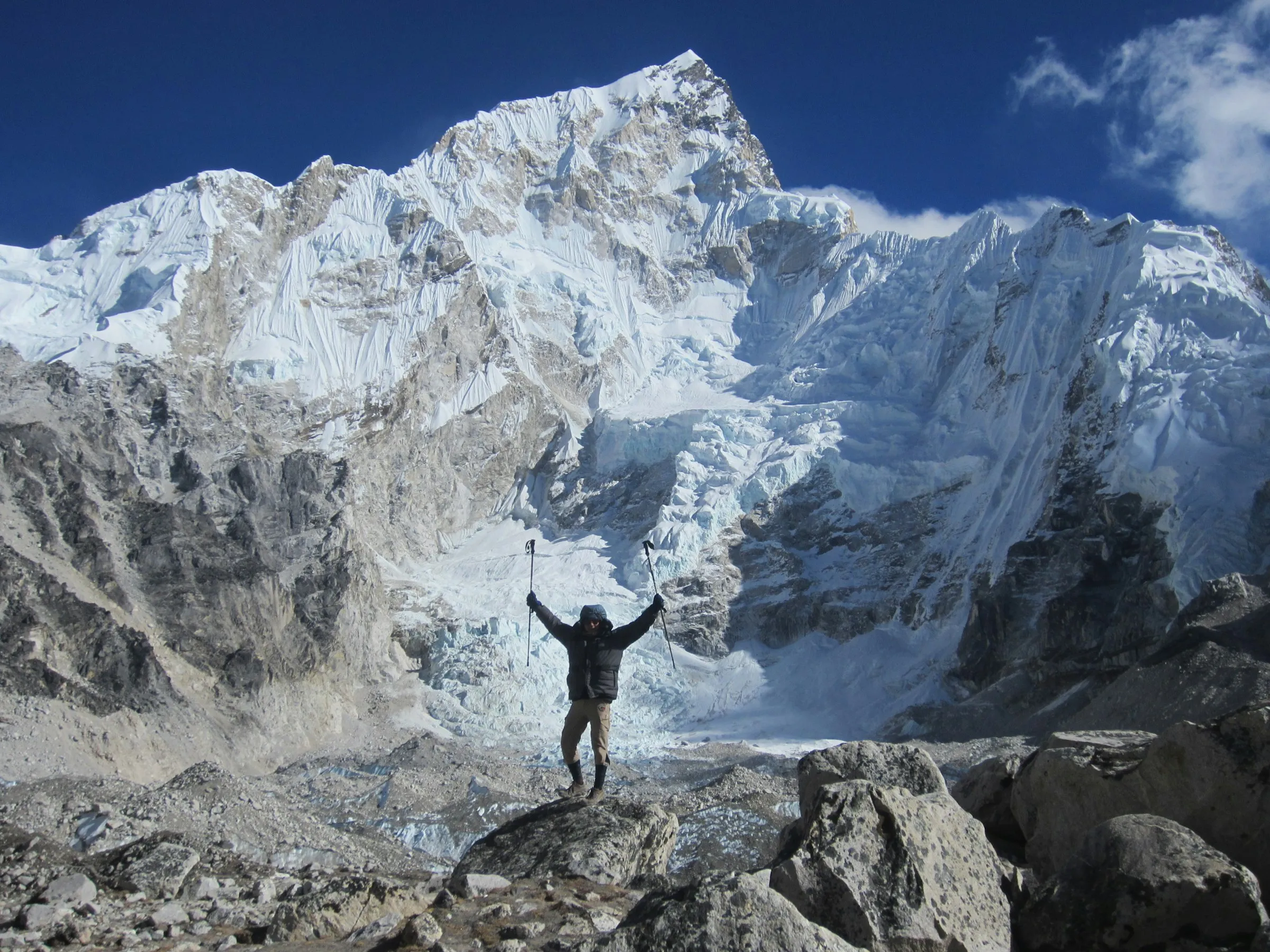
Everest Base Camp is a trek, not a climb, and thousands of people walk it safely every year. The risks are real, though, and most of them come from altitude, not from the trail itself.
The main risks
- Altitude sickness. You spend many nights above 4,000 m. It can affect anyone, and the most serious forms can be fatal if ignored. Read the simple rules.
- Cold. Nights at Gorak Shep are well below freezing for most of the year (see the table below).
- Trail hazards. Steep drops, suspension bridges, loose rock on moraine, and yak and porter trains that need room to pass. Always step to the uphill side when animals pass.
- Weather and flights. Lukla flights are often delayed, which can pressure people to rush the itinerary. Don’t.
How high you actually sleep
The highest point you stand on is Kala Patthar at 5,545 m, but for altitude sickness the number that matters is where you sleep. On our 12-day itinerary you sleep above 3,000 m on nine nights and above 4,000 m on five: two at Dingboche (4,410 m), then Lobuche (4,940 m), Gorak Shep (5,164 m) and Pheriche (4,240 m) on the way down. Gorak Shep is the highest night.
The usual guideline is that once you sleep above 3,000 m, you raise your sleeping altitude by no more than about 500 m a day (Wilderness Medical Society guidelines, 2024 update). The Khumbu’s villages don’t fall at neat 500 m steps, so three nights on our plan climb faster than that: Namche Bazaar (+830 m), Dingboche (+550 m) and Lobuche (+530 m). The rest days at Namche and Dingboche come straight after the first two. The day-by-day altitude page shows every climb, and how many days you need explains why shorter itineraries are riskier.
How it compares with other treks
The same check, run on our other itineraries, puts Everest Base Camp in context. All figures come from each trek’s itinerary and the stop elevations on its altitude page.
| Trek | Days | Highest night | Nights above 4,000 m | Nights over the 500 m guideline | Rest days |
|---|---|---|---|---|---|
| Everest Base Camp | 12 | 5,164 m | 5 | 3 | 2 |
| Annapurna Circuit | 12 | 4,450 m | 2 | 2 | 1 |
| Annapurna Base Camp | 10 | 4,130 m | 1 | 2 | 0 |
| Langtang Valley | 8 | 3,870 m | 0 | 1 | 1 |
Everest Base Camp sleeps higher, and for longer, than any of the others. Higher does not always mean faster, though: the two fast nights on Annapurna Base Camp are bigger jumps (+920 m and +900 m) than any night on the Everest route, with no rest day. See Everest Base Camp vs Annapurna Circuit, Everest Base Camp vs Langtang Valley and Annapurna Base Camp vs Everest Base Camp.
How cold the nights get
Average night-time lows, by month, at three of the places you sleep. These are modelled 10-year averages (2016 to 2025, ERA5 / ERA5-Land via Open-Meteo), not readings from one night, so a cold snap can be several degrees lower.
| Month | Namche (3,440 m) | Dingboche (4,410 m) | Gorak Shep (5,164 m) |
|---|---|---|---|
| March | -2.0 °C | -8.8 °C | -14.2 °C |
| April | 1.9 °C | -4.7 °C | -10.0 °C |
| May | 5.2 °C | -0.9 °C | -5.5 °C |
| October | 5.2 °C | -1.4 °C | -6.0 °C |
| November | 1.1 °C | -5.6 °C | -10.6 °C |
| December | -1.8 °C | -8.6 °C | -13.6 °C |
| January | -5.4 °C | -12.4 °C | -17.4 °C |
At Gorak Shep the average low is below freezing in eight months of the year, October to May. Teahouse rooms are simple twin rooms with foam mattresses and blankets, and the stove is in the shared dining room, so plan your sleeping bag around the Gorak Shep figure for your month. Night temperatures on Nepal treks has every month for every trek.
Which months are safer
We plan Everest Base Camp for March to May and October to November, when the weather is most stable. September, December and February are possible with more trade-offs. In the monsoon (June to September) cloud hides the peaks and mountain flights are delayed more often, which adds to the pressure on your itinerary. In winter the trails are quiet and often clear, but nights at the highest stops are far below freezing and some lodges close. The weather page has day and night temperatures for each stop.
Is it safe without a guide?
Nepal’s 2023 rule requiring a licensed guide in national parks has not been applied in the Khumbu; the region was still exempt as of February 2025 (Kathmandu Post). So walking without a guide is allowed, but it moves the safety work onto you. The rules above still apply: nobody else is watching for symptoms, and you have to make the turn-back call yourself. If you go independently, walk with a partner and agree the rules before you start. See do I need a guide in Nepal and trekking solo in Nepal.
How to reduce them
- A sensible itinerary with rest days. Ours includes two, at Namche and Dingboche.
- A guide who checks on you every evening and turns back when needed.
- Never going higher with symptoms.
- Travel insurance that covers trekking to at least 6,000 m and helicopter evacuation. See travel insurance for high-altitude treks.
Rescue
If someone becomes seriously ill, the first step is to descend. Helicopter evacuation is available in the Everest region when it’s medically needed. We take no commissions on rescues. See our promises.
Deaths among trekkers are rare. The best published figures, from Himalayan Rescue Association data across Nepal, found about 14 to 15 deaths per 100,000 trekkers, most from altitude illness (Shlim & Houston, JAMA, 1989; Shlim & Gallie, 1992). Those studies are decades old, and there’s no reliable current figure for the Everest region alone, but the lesson still holds: altitude is the main risk, and going slowly is the main defence.