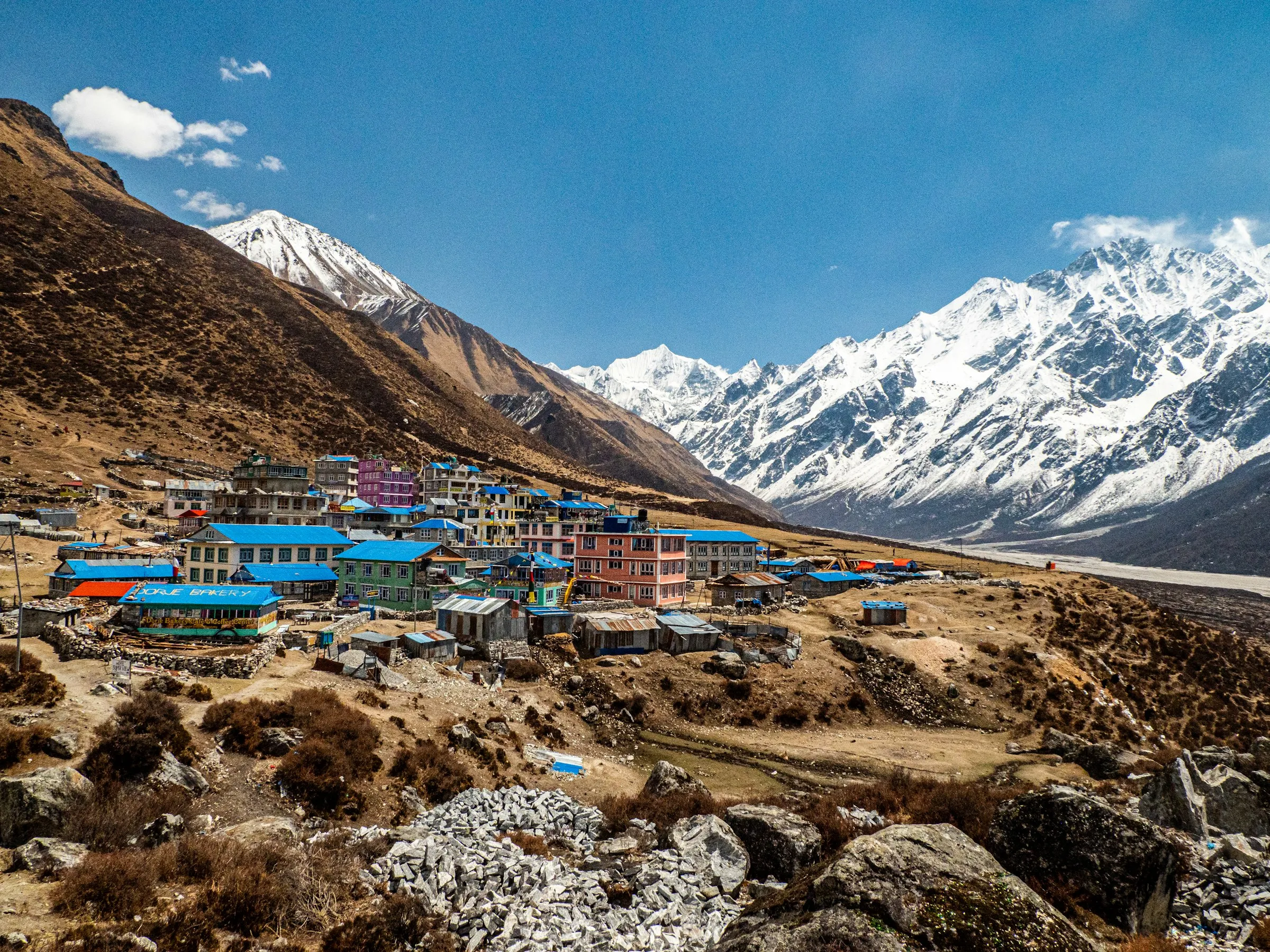
On 25 April 2015, the Gorkha earthquake struck Nepal. In the Langtang valley, it triggered a huge avalanche and landslide that buried Langtang village, killing villagers, trekkers and guides. It was one of the worst single disasters of the earthquake.
Roughly 300 to more than 350 people were killed or never found, including foreign trekkers; the exact number is uncertain because many bodies were never recovered (Kargel et al., Science, 2016; Al Jazeera, 2025).
The earthquake shook loose ice and rock high on the peaks above the valley. Al Jazeera puts the mass that came down at an estimated 40 million tonnes, and says only one building in the old village was left standing. Nepal-wide, the magnitude 7.8 earthquake killed about 9,000 people (Al Jazeera, 2025).
Where the valley is
Langtang is the closest of the big trekking valleys to Kathmandu: you reach the trailhead at Syabrubesi (1,460 m) by road, with no flight. The trail climbs through Lama Hotel (2,470 m) to Langtang village (3,430 m) and Kyanjin Gompa (3,870 m), the last settlement, below the viewpoint of Kyanjin Ri (4,600 m).
The whole valley lies inside Langtang National Park, set up in 1976 as Nepal’s first Himalayan national park. It covers 1,710 km², managed by the Department of National Parks and Wildlife Conservation (Wikipedia). That is why you pay a national park entry fee on this trek.
The valley today
Families returned and rebuilt. Teahouses now line the trail again, Langtang village stands a short way from where the old village was, and Kyanjin Gompa welcomes trekkers as before. A memorial near the site remembers those who died.
The old site could not be cleared: machinery could not dig out the debris, and space inside the national park is limited, so the new village was built nearby. Rebuilding was largely led by the villagers themselves through the Langtang Management and Reconstruction Committee, formed three months after the earthquake. Of the roughly 50 families who lived in the village before, fewer than half live there today (Al Jazeera, 2025).
Tourism since the rebuild
Tourism is the valley’s main income. After the earthquake nearly every house in Langtang village became a guesthouse. Residents quoted by Al Jazeera are open about the trade-off: more income, but less of the quieter life they had before (Al Jazeera, 2025).
Every night you spend in a Langtang teahouse and every meal you eat there supports the families who chose to come back.
Health care on the trail
Ten years on, there is still no health facility in Langtang village itself; the nearest is a basic clinic with a paramedic in neighbouring Mundu (Al Jazeera, 2025). You sleep at Kyanjin Gompa, 3,870 m, so plan the climb with care, carry travel insurance that covers helicopter evacuation at the height you will reach, and turn back if symptoms get worse. Our altitude page for Langtang lists every night’s height, and the insurance guide covers what to check in a policy.
Visiting respectfully
- Ask before photographing people, homes or the memorial.
- Buy food and drinks in local teahouses rather than carrying everything in.
- Ask your guide about the valley’s story; many guides from the region have family ties to it.